Salon owners are no longer asking whether they need software. They are asking which platform actually uses AI in ways that save time, protect revenue, and improve the client experience.
Search trends reflect it. Queries like "which salon software has the best AI features" and "which salon management platforms are leading the way with AI-powered tools today" are showing up with thousands of impressions — because owners know AI is everywhere in marketing copy, but not every platform delivers it where the business actually runs.
This guide breaks down what AI in salon software should mean in 2026, which platforms are leading in different categories, and how to choose the right fit for your business — whether you run a solo suite, a multi-chair salon, or a full spa.
What "AI Features" Actually Mean in Salon Software
Before comparing platforms, it helps to define what matters.
A lot of salon software now says "AI-powered." That can mean anything from a basic chatbot to genuinely useful automation across booking, communication, marketing, and operations.
In 2026, the AI features worth paying for usually fall into six categories:
1. AI Receptionist and Client Communication
Tools that draft replies to DMs, emails, and booking inquiries based on your services, policies, and availability — so you are not rewriting the same answers every day.
This is especially valuable for makeup artists, bridal pros, and high-volume stylists who live in Instagram messages. See our guide on AI receptionists for makeup artists for a role-specific breakdown.
2. Smart Scheduling and Capacity Management
AI that goes beyond storing appointments — matching services to the right provider, building in processing time, reducing gaps, flagging no-show risk, and filling cancellations faster.
For salon owners, this connects directly to profitability. Reducing no-shows and protecting chair time is one of the fastest ways to grow revenue without adding hours.
3. AI Marketing and Retention
Drafting email and SMS campaigns, personalizing rebooking messages, generating social content, segmenting clients, and automating review requests.
If you already use email marketing, AI should make consistency easier — not add another disconnected tool.
4. Business Intelligence and Reporting
Turning appointment, retail, and staff data into decisions: which services are most profitable, which providers retain best, which promotions actually work.
Most legacy salon software stores this data. AI-powered platforms help explain it.
5. Intake, Consultation, and Client Preparation
Smart forms, AI-assisted questionnaires, and consultation prep that reduce back-and-forth before appointments.
Digital intake forms are becoming standard — AI makes them faster to build and easier to personalize.
6. Visual and Creative AI
Image generation for social content, style previews, nail art concepts, lash mapping ideas, and treatment education visuals.
Different models excel at different creative tasks. Platforms that use the right model for each job — rather than one generic chatbot for everything — tend to produce better results. Our ChatGPT vs. ProBeauty AI breakdown explains why that matters.
The bottom line: The best salon software with AI features is not the one with the most buzzwords. It is the one that connects AI to the workflows you already depend on — booking, clients, communication, and growth.
Salon Software AI Comparison: At a Glance
This table is a practical starting point. Every platform evolves quickly, so treat it as a decision framework — not a permanent ranking.
| Platform | Best For | Standout AI Strengths | Typical Limitation |
|---|---|---|---|
| ProBeauty AI | Beauty pros who want AI-native booking + business ops in one place | AI receptionist, beauty-specific chat, image templates, intake, marketing, model-flexible AI across workflows | Newer platform; best fit for beauty-first businesses rather than large fitness/wellness hybrids |
| Boulevard | Upscale salons and spas prioritizing client experience | Strong UX, marketing automation, client journey tools | Premium pricing; AI depth varies by plan and use case |
| Zenoti | Multi-location spas, med spas, and enterprise operators | Advanced analytics, enterprise automation, scale | Can be complex and expensive for small salons |
| Mangomint | Modern independent salons and growing teams | Clean interface, strong scheduling, good operational tools | AI features are growing but not the primary product identity |
| Vagaro | Broad salon/spa/fitness businesses needing many features | Wide feature set, marketplace exposure, payments | Can feel busy; AI is not always deeply integrated across workflows |
| Fresha | Solo pros and salons wanting marketplace discovery | Free tier, strong booking marketplace, payments | AI features are lighter; marketplace model may not suit every brand |
| Phorest | Salon-focused teams, especially in certain markets | Salon-specific workflows, marketing, retention tools | AI capabilities depend on region and product roadmap |
| GlossGenius | Solo stylists and suite renters | Simple mobile-first experience, payments, booking | Limited for multi-provider salons; lighter on advanced AI ops |
| Mindbody | Wellness, fitness, and spa hybrids | Large ecosystem, enterprise tools | Less beauty-specific; can feel heavy for traditional salons |
How to read this: There is no single "best" platform for everyone. The right choice depends on your size, service mix, budget, and whether you need AI for communication, operations, marketing, or all three.
Which Salon Management Platforms Lead With AI Today?
Here is how the leading platforms compare across the use cases salon owners care about most.
ProBeauty AI — Best for AI-Native Beauty Workflows
ProBeauty AI was built around a different assumption than legacy salon software: beauty professionals should not need five apps and three AI subscriptions to run one business.
Where it leads:
- AI receptionist and client communication trained on beauty business context
- Booking, intake, reminders, and follow-ups in one connected system
- AI image templates for real beauty use cases — hair, nails, lashes, makeup, skincare
- Marketing and business support connected to your services and clients
- Model-flexible AI — the right capability for chat, images, research, and writing without managing multiple tools yourself
ProBeauty AI makes the most sense when you want AI inside the business — not beside it. If you are comparing general chatbots to beauty software, start with what ProBeauty AI actually does and our complete guide to AI for beauty professionals.
Best fit: Solo pros, salon owners, estheticians, nail techs, lash artists, and makeup artists who want one modern platform instead of a fragmented stack.
Boulevard — Best for Premium Client Experience
Boulevard has earned a strong reputation among upscale salons and spas that prioritize polished client journeys.
AI strengths: Marketing automation, client communication workflows, and experience-focused features that help high-end businesses feel consistent at every touchpoint.
Watch for: Premium pricing and a feature set oriented toward established salons. AI is present, but owners should evaluate whether it covers their specific operational bottlenecks — not just marketing.
Best fit: Established salons and spas with higher average tickets and a strong emphasis on brand experience.
Zenoti — Best for Enterprise and Multi-Location Operators
Zenoti is built for scale — med spas, large spa groups, and multi-location businesses that need deep operational control.
AI strengths: Analytics, enterprise automation, and tools designed for complex organizations with many providers, locations, and service lines.
Watch for: Implementation complexity and cost. Powerful for the right operator, but often more than a single-location salon needs.
Best fit: Multi-location spas, med spas, and enterprise beauty/wellness groups.
Mangomint — Best for Modern Salons That Want Clean Operations
Mangomint has become a favorite among salon owners who want software that feels current — strong scheduling, team management, and a polished interface.
AI strengths: Growing automation around operations and client experience. Strong on the fundamentals of running a modern salon well.
Watch for: AI is improving, but Mangomint's identity is still rooted in excellent salon operations more than AI-first workflows.
Best fit: Independent salons and growing teams that want modern software without enterprise complexity.
Vagaro — Best for Feature Breadth
Vagaro covers a wide surface area: booking, payments, marketplace, fitness, and more.
AI strengths: Broad platform with many tools in one subscription. Useful for businesses that want everything under one roof.
Watch for: The interface can feel crowded. AI depth may vary depending on which features you actually use day to day.
Best fit: Salons, spas, or hybrid businesses that want a wide feature set and marketplace exposure.
Fresha — Best for Discovery and Solo Pros
Fresha's marketplace model helps new clients find providers — a major advantage for independents building a book.
AI strengths: Strong booking and payments infrastructure with a large client discovery network.
Watch for: Lighter AI for business operations, marketing depth, and beauty-specific workflows. The marketplace model is not right for every brand.
Best fit: Solo providers and salons that prioritize new client discovery over advanced AI operations.
Phorest — Best for Salon-Focused Teams
Phorest has long focused on the salon category specifically — marketing, retention, and salon-native workflows.
AI strengths: Salon-specific tools for campaigns, client retention, and team performance.
Watch for: AI capabilities and integrations can vary by market. Worth comparing directly against your must-have workflows.
Best fit: Salon teams that want software built specifically for hair and beauty businesses.
GlossGenius — Best for Solo Stylists and Suite Renters
GlossGenius offers a simple, mobile-first experience that resonates with independents.
AI strengths: Easy booking, payments, and client management without overwhelming complexity.
Watch for: Limited for multi-chair salons and lighter on advanced AI for marketing, intake, and business intelligence.
Best fit: Solo stylists, booth renters, and suite professionals who want simplicity.
How to Choose the Right Salon Software With AI
Use this decision framework before you commit to a platform or switch from your current one.
Step 1: Name Your Biggest Bottleneck
AI is only useful if it solves a real problem.
If your bottleneck is unanswered messages and lost bookings → prioritize AI receptionist, DM support, and fast inquiry response.
If your bottleneck is empty chairs → prioritize smart scheduling, reminders, waitlists, and rebooking automation.
If your bottleneck is inconsistent marketing → prioritize AI email, SMS, social content, and review requests.
If your bottleneck is weak margins → prioritize reporting, service profitability, and retail insights.
If your bottleneck is team inconsistency → prioritize onboarding, SOPs, scripts, and performance visibility.
Salon owners who start with the right problem see ROI faster. Our guide to 5 AI tools every salon owner should use breaks this down by category.
Step 2: Match Software to Business Model
Solo stylist or suite renter: You need simplicity, mobile access, and AI that handles communication without a front desk team. GlossGenius, Fresha, or ProBeauty AI are common starting points depending on whether you prioritize discovery, simplicity, or AI depth.
Multi-chair salon: You need provider scheduling, team coordination, and owner-level reporting. Mangomint, Vagaro, Phorest, Boulevard, or ProBeauty AI depending on size and budget.
Spa or med spa: You may need advanced intake, longer service times, room management, and retail integration. Boulevard, Zenoti, or Vagaro are often in the conversation.
Beauty specialist (esthetician, nail tech, lash artist, MUA): Generic salon software often misses role-specific workflows. Look for platforms with strong intake, visual tools, and communication support. ProBeauty AI, GlossGenius, or Vagaro — plus role guides like AI tools for estheticians, nail techs, and lash artists.
Step 3: Count Your Logins
The hidden cost of salon software is not always the monthly fee. It is the stack.
One tool for booking. Another for forms. Another for email. Another for AI writing. Another for images. Another for reviews.
Every disconnected tool creates copy-paste work and context loss. Before buying, ask: Does this platform reduce my app count or add to it?
Step 4: Test the AI Where You Actually Work
Do not evaluate salon AI from a marketing page alone.
Run real scenarios during a trial:
- A client DMs asking about pricing and availability on a Saturday night
- A first-time client needs intake before a chemical service
- A loyal client has not rebooked in 90 days
- You need a week's worth of Instagram content for a new service
- You want to know which service has the best profit per hour
The platform that handles your real workflows — not just a demo prompt — is the one worth paying for.
Step 5: Check Adoption Fit for Your Team
The best software fails if your team will not use it.
Look for:
- Clean mobile experience for providers
- Simple front desk workflows
- Clear permissions by role
- Easy client-facing booking pages
- Minimal training burden
AI should reduce chaos, not create another system people work around.
Software vs. Equipment vs. Technology: What Owners Often Miss
Salon owners searching for "AI-powered tools" are often mixing three different investments:
- Salon software — booking, clients, marketing, operations
- Treatment equipment — devices, chairs, tools used in services
- Beauty care technology — the full stack of digital and physical innovation shaping client experience
These overlap, but they are not the same purchase decision.
Your software should connect to how you run the business. Your equipment should connect to what happens in the treatment room. And the broader beauty industry equipment trends shaping 2026 — from LED devices to ergonomic furniture — are worth understanding separately from your booking platform.
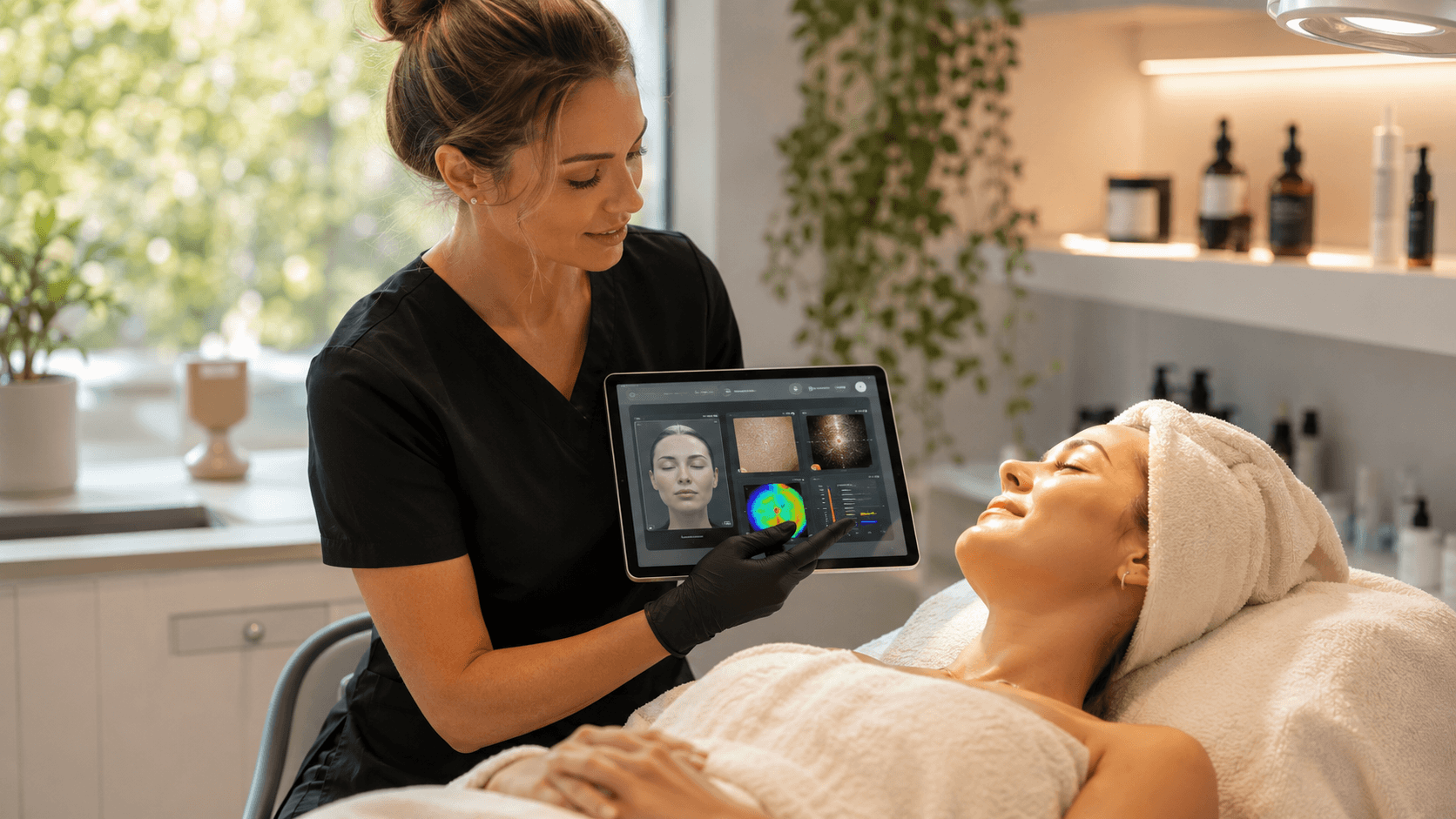
We are also seeing rapid growth in searches around beauty care technology advancements — AI skin analysis, connected devices, virtual consultations, smart retail, and digital client education. That is a distinct topic from both equipment buying guides and salon software comparisons. Watch for our upcoming deep dive on beauty care technology in 2026, which will cover how software, devices, and client-facing tech work together.
Practical takeaway: Choose salon software for operations and growth. Choose equipment for service delivery. Choose technology strategy for how both connect to the client experience.
What Estheticians and Spa Operators Should Look For
Estheticians have specific needs that generic salon software sometimes overlooks:
- Detailed intake and contraindication tracking
- Treatment room and device scheduling
- Before/after documentation
- Retail and homecare recommendations tied to treatments
- Rebooking cadences based on treatment plans
AI can help with consultation prep, follow-up messaging, and client education — but only if the platform understands skincare workflows.
If you run an esthetics practice, pair your software evaluation with treatment and retail strategy. Skincare results depend on what happens in the room and what clients use at home. We are publishing a guide to top professional skincare lines for estheticians soon — covering how to choose lines by clientele, margins, and treatment compatibility. In the meantime, our esthetician AI tools guide and skincare treatment trends for 2026 cover the service side of the equation.
Common Mistakes When Choosing AI Salon Software
Avoid these traps:
❌ Choosing AI that only writes captions — Social content helps, but reception, booking, intake, and retention usually matter more.
❌ Paying for enterprise software too early — A solo stylist does not need a platform built for 50 locations.
❌ Ignoring marketplace tradeoffs — Discovery marketplaces can bring clients, but they also shape pricing, branding, and client ownership.
❌ Switching software without fixing workflows — AI automates processes. Bad processes automated still create problems.
❌ Assuming all AI is the same — A generic chatbot is not the same as AI connected to your services, clients, and booking rules.
❌ Buying features your team will not use — Simpler software adopted fully beats advanced software ignored half the time.
The Platforms "Leading the Way" in 2026 — Honestly
If you want a direct answer to which salon management platforms are leading with AI-powered tools today, here is the honest version:
Leading for AI-native beauty workflows: ProBeauty AI — built around AI inside booking, clients, communication, intake, images, and marketing rather than bolted on as an afterthought.
Leading for premium salon/spa experience: Boulevard — strong client journey and marketing automation for upscale businesses.
Leading for enterprise scale: Zenoti — deep operational and analytics capabilities for multi-location operators.
Leading for modern salon operations: Mangomint — excellent scheduling and team tools with growing automation.
Leading for breadth and marketplace reach: Vagaro and Fresha — wide feature sets and client discovery, with lighter AI depth in some areas.
Leading for salon-focused marketing and retention: Phorest — long-standing salon category focus.
Leading for solo simplicity: GlossGenius — mobile-first ease for independents.
The "best" platform is the one that matches your size, service mix, and biggest bottleneck — and actually gets used by you and your team every week.
What to Do Next
If you are evaluating salon software with AI features in 2026, start here:
- Write down your top three daily frustrations — messages, empty chairs, marketing, intake, reporting, or team consistency.
- Shortlist two or three platforms using the comparison above.
- Run real scenarios in free trials — not just feature tours.
- Count how many tools each platform replaces — fewer logins usually means less friction.
- Read role-specific guides for your business type — salon owners, hairstylists, estheticians, nail techs, and makeup artists.
The salons and spas that win in 2026 will not necessarily have the most software. They will have the right software — connected, adopted, and working quietly in the background while the team focuses on clients.
That is what AI in salon management should do. Not more complexity. More clarity.
ProBeauty AI is salon software built for beauty professionals who want AI-native booking, client management, intake forms, marketing, image templates, and business support in one platform. Get started free.