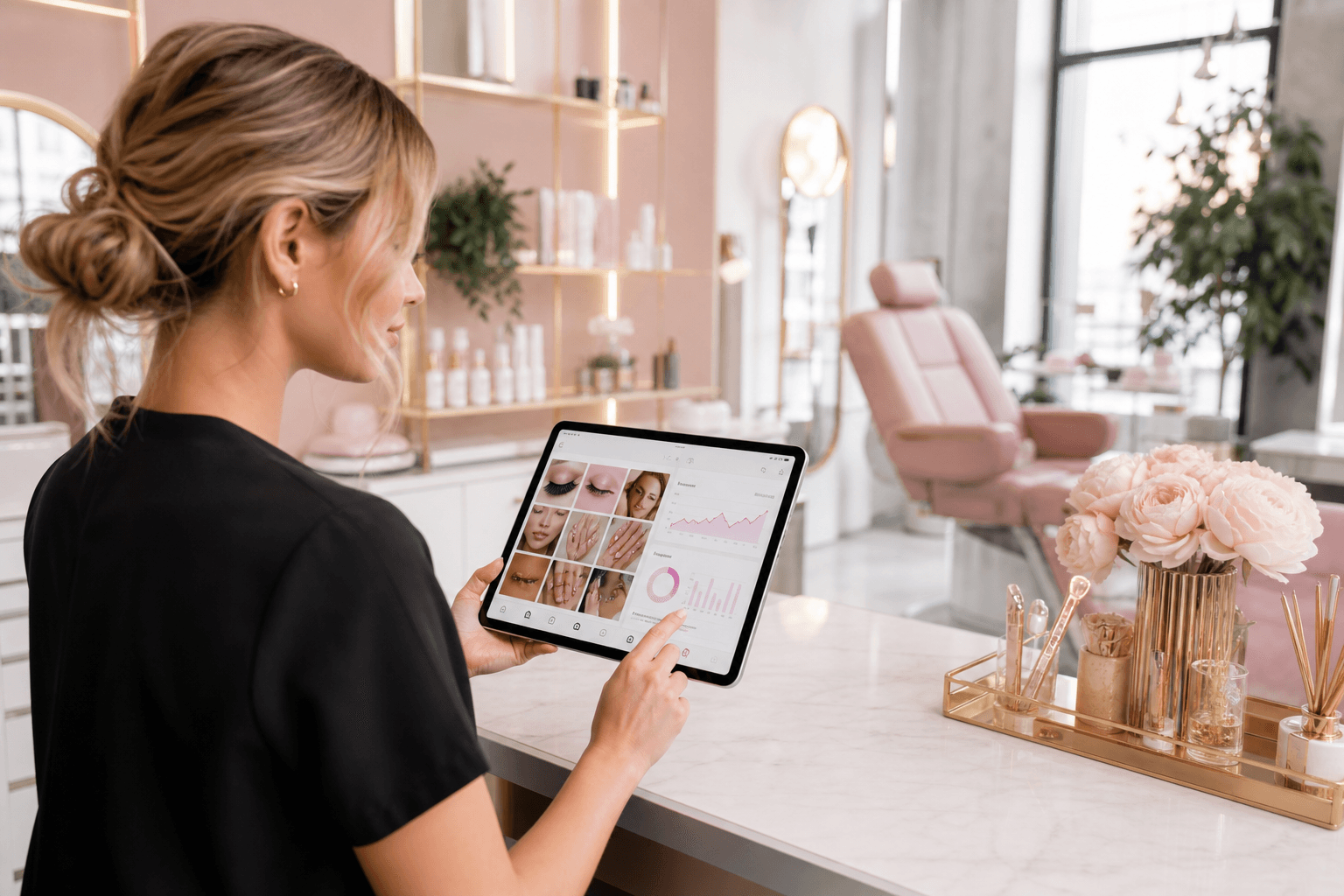
Marketing in the beauty industry has never moved faster. Clients discover you on Instagram at midnight, compare reviews on Google before breakfast, and book through a link in your bio before you finish your first coffee. The professionals winning in 2026 are not necessarily the most talented — they are the ones whose marketing systems keep pace with how clients actually search, scroll, and decide.
If you searched "beauty marketing trends 2026" or "beauty industry digital marketing trends 2026," you are in the right place. This guide covers what is actually working for salons, spas, estheticians, and beauty businesses right now — and what to prioritize if you are building (or rebuilding) your marketing from scratch.
Why Beauty Marketing Looks Different in 2026
Three shifts are reshaping how beauty professionals attract and retain clients:
Discovery moved to social and search. Over 70% of consumers research beauty businesses on social media before booking. Google Search and AI-powered answers are sending high-intent traffic to businesses with strong content, reviews, and structured online presence.
Attention spans shortened, but trust requirements grew. Clients want quick, scroll-stopping content — but they also want proof. Before-and-afters, reviews, educational posts, and consistent branding all matter more than polished perfection.
AI changed the economics of marketing. What used to take hours — captions, email campaigns, DM replies, promotional graphics — can now be drafted in minutes. The professionals using AI are not replacing their voice. They are showing up more consistently than competitors who post sporadically.
The trends below reflect what is driving clicks, bookings, and rebookings across the beauty industry in 2026.
1. Short-Form Video Is the Primary Growth Channel
If there is one marketing format beauty professionals cannot ignore in 2026, it is short-form video.
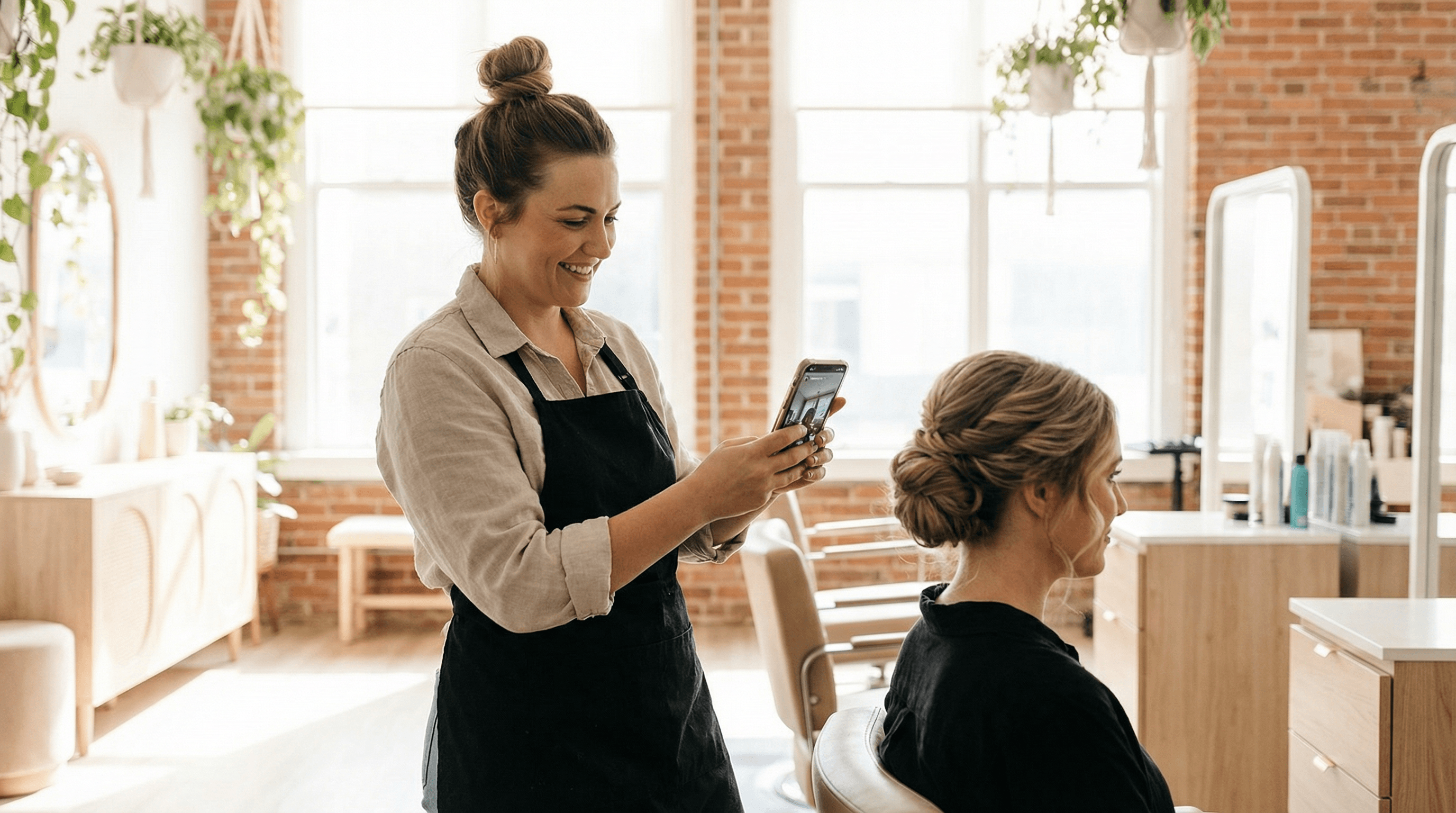
Instagram Reels and TikTok are where new clients discover salons, spas, and independent beauty pros — often before they ever visit your website or Google listing. The algorithm rewards consistency, not follower count. A single strong Reel can outperform months of static posts.
What performs best for beauty businesses:
- Transformation reveals — before-and-after color, lashes, nails, skin results
- Process videos — satisfying application footage, technique close-ups, "watch me work"
- Educational hooks — "3 signs your skin barrier is damaged," "what to expect at your first facial"
- Behind-the-scenes — day-in-the-life, team culture, product restocks, studio tours
- Trending audio with beauty context — adapt trending sounds to your niche without forcing it
Instagram Reels tips for salons and spas in 2026:
- Post Reels 3–5 times per week if growth is a priority; minimum 2 for maintenance
- Hook viewers in the first 2 seconds — show the result or ask a question immediately
- Add on-screen text — most people watch without sound
- Use a clear CTA in caption: "Book link in bio," "DM us AVAILABILITY," or "Comment SKIN for our guide"
- Repurpose TikToks as Reels (remove watermarks) and vice versa
- Pin your best-performing Reel to your profile — it works like a billboard
Verdict: Short-form video is no longer optional for salons and spas that want new client flow. It is the top of your marketing funnel.
→ Social Media Marketing for Salons and Spas: A Complete Guide
2. AI-Powered Content Creation Goes Mainstream
The beauty professionals posting consistently in 2026 are not spending three hours every evening on captions. They are using AI to draft, refine, and schedule — then adding their personal touch before publishing.
Where AI marketing helps most:
- Caption and hook writing for Reels, carousels, and Stories
- Email campaign drafts for promotions, rebooking nudges, and seasonal offers
- DM and comment reply templates that sound like you, not a robot
- Promotional graphics and image concepts for posts, stories, and ads
- Content calendars organized by service, season, and client type
The shift is not "let AI run my marketing." It is "let AI remove the blank-page problem so I actually post."
Generic AI tools can help with copy. Beauty-specific platforms connect that output to your actual business — your services, your booking link, your client follow-ups — so marketing is not a separate job from running the business.
→ AI for Beauty Professionals: The Complete 2026 Guide
→ ChatGPT vs. ProBeauty AI for Beauty Professionals
3. DM and Comment Automation as a Marketing Channel
Your Instagram DMs are not just customer service. They are a sales channel — and in 2026, they are one of the highest-converting touchpoints in beauty marketing.
Clients DM to ask about pricing, availability, lash styles, color consultations, and "do you have openings this Saturday?" The businesses that respond within minutes win the booking. The ones that respond tomorrow lose it to someone else.
What is trending:
- Automated first responses that acknowledge inquiries instantly
- FAQ flows for pricing, location, hours, and booking links
- Comment-to-DM automations — "Comment BOOK and we'll send you the link"
- WhatsApp and Facebook Messenger integrations for clients who prefer those channels
- Bilingual responses for businesses serving English and Spanish-speaking clients
This is especially relevant for queries like "AI tools to help with beauty parlour business" — the professionals searching for this are not looking for more content ideas. They want systems that capture leads while they are with clients.
→ What Is ProBeauty AI?
4. Google Reviews and Local SEO as Marketing Infrastructure
Social media gets attention. Google gets intent.
When someone searches "facial near me," "lash extensions [city]," or "best spa downtown," Google Business Profile results and reviews determine who gets the click. Beauty marketing in 2026 treats local SEO as foundational — not an afterthought.
What works:
- Systematic review requests after every appointment (text or email with a direct link)
- Responding to every review — positive and negative — professionally and promptly
- Google Business Profile updates with photos, services, and posts at least monthly
- Location-specific content on your website and blog
- Consistent NAP (name, address, phone) across directories
Your average position in search results directly affects how many impressions turn into clicks. A 0.4% CTR with high impressions — common for beauty businesses ranking on page one but with weak titles or snippets — often improves dramatically with better meta descriptions, review volume, and content that matches search intent.
→ How to Build a 5-Star Reputation for Your Beauty Business
5. Email Marketing's Quiet Comeback
While everyone chases viral Reels, the beauty businesses with the most predictable revenue are often running strong email programs.
Email delivers direct access to clients without algorithm interference. It is the best channel for:
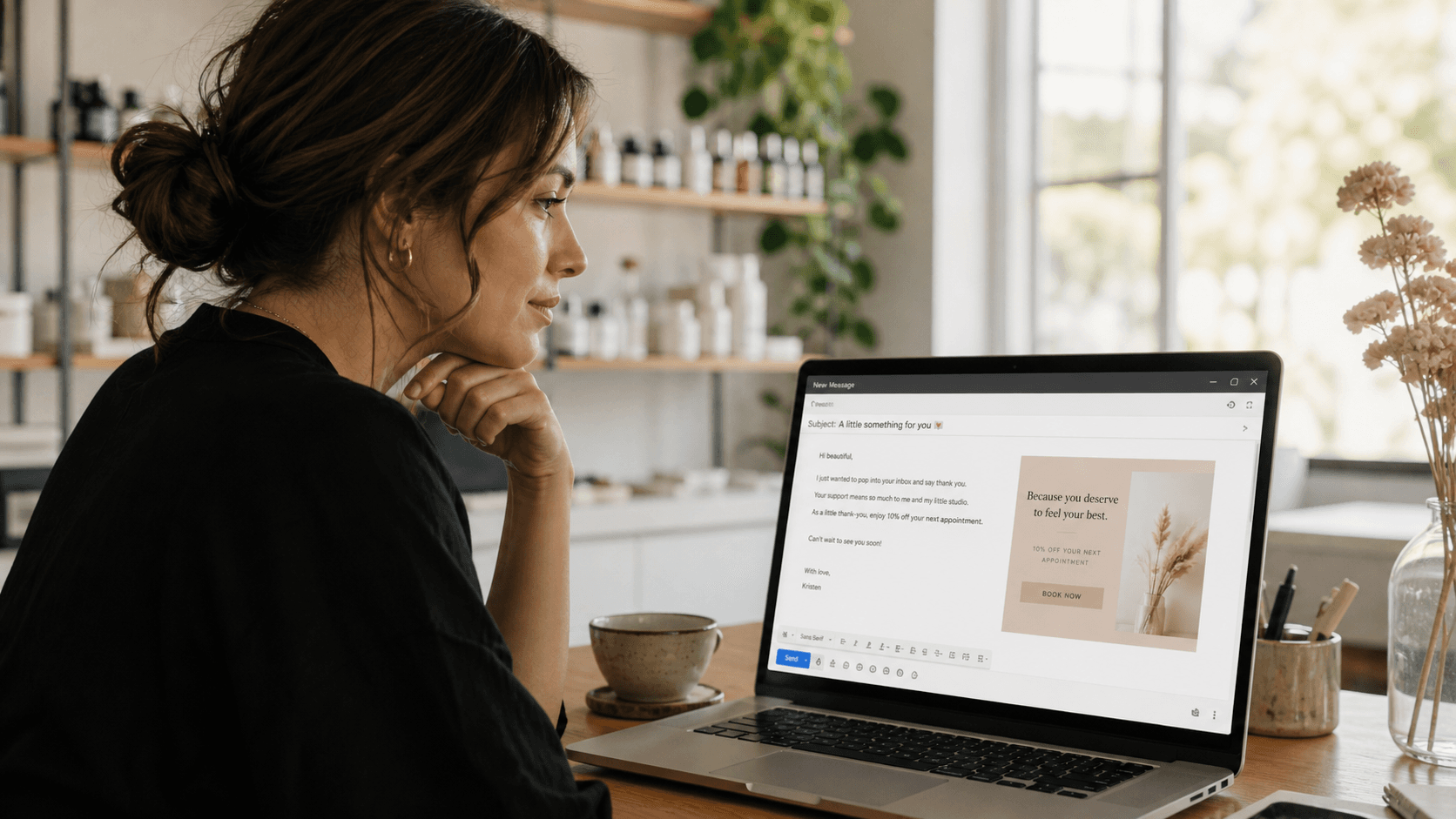
- Rebooking reminders when clients are due for their next visit
- Seasonal promotions (spring skin prep, holiday glam, back-to-school cuts)
- New service launches to your existing warm audience
- Educational nurture sequences for leads who have not booked yet
- Win-back campaigns for clients who have not visited in 90+ days
The trend in 2026 is not mass promotional blasts. It is segmented, personalized email — different messages for new clients, VIPs, lash fill clients, and bridal inquiries.
→ Email Marketing for Beauty Professionals: The Complete Guide
6. Educational Content Marketing Builds Authority
Beauty clients in 2026 research before they book. They read blog posts, watch tutorials, and compare providers. The businesses publishing helpful educational content capture that research traffic and convert it into trust.
High-performing content types:
- Trend guides (equipment, treatments, color, nails, skincare)
- "How to choose" articles (esthetician, lash style, hair color)
- Service explainers ("What is a HydraFacial?" "How long do lash extensions last?")
- Local guides ("Best pre-wedding skincare timeline")
- Business advice for other pros (if you are building B2B authority)
This is why comprehensive guides on topics like beauty industry equipment trends, skincare treatment trends, and how to become an esthetician attract thousands of impressions — clients and aspiring pros are searching for answers. The businesses that answer those questions earn visibility.
7. User-Generated Content and Client Photo Programs
Polished studio content builds your brand. Client-generated content builds social proof.
Trending approaches in 2026:
- Photo release forms built into digital intake (streamlined consent)
- "Tag us for a chance to be featured" campaigns
- Reposting client selfies (with permission) to Stories and feed
- Review screenshots as social proof posts
- Bridal and event photo follow-up — requesting professional wedding/event photos months later
One authentic client photo often outperforms a professionally shot campaign because it signals real results from real people.
8. Micro-Influencer and Local Partnership Marketing
Mega-influencer deals are out of reach for most salons and spas. Micro-influencer and local partnership marketing is the accessible alternative — and it is trending hard in 2026.
What works:
- Partnering with local lifestyle creators (5k–50k followers) for service exchanges
- Cross-promotions with complementary businesses (yoga studios, bridal shops, photographers)
- Referral programs with tracking links or codes
- Staff as micro-influencers — encouraging team members to post their work with consistent branding
- Neighborhood geo-tags and local event sponsorships
The goal is credible, local visibility — not viral fame.
9. Personalization at Scale
Clients expect marketing that feels relevant to them. Generic "20% off everything" blasts are losing ground to targeted offers.
Personalization trends:
- Birthday and anniversary messages with exclusive offers
- Service-specific rebooking windows (lash fills at 2 weeks, facials at 4–6 weeks, color at 6–8 weeks)
- Product recommendations based on treatment history
- Segmented email lists by service type, visit frequency, and spend
- Personalized follow-up after visits — not just "thanks for coming"
The businesses reducing churn are not guessing when clients are due. They have systems that track visit patterns and trigger outreach automatically.
→ Client Retention Strategies for Beauty Professionals
10. SMS and WhatsApp as Direct Marketing Channels
Text messaging has some of the highest open rates of any marketing channel — often 90%+. In 2026, beauty businesses are using SMS and WhatsApp strategically for:
- Appointment reminders and confirmations
- Last-minute opening announcements
- Rebooking nudges
- Flash promotions to VIP lists
- Post-visit care instructions
Important: Always get explicit opt-in. Unsolicited texts damage trust and may violate regulations. The trend is permission-based, high-value messages — not spam.
For businesses serving Latino communities and international clients, WhatsApp marketing is especially powerful. Bilingual automation is a competitive advantage, not a nice-to-have.
11. Spa Promotion and Social Media Tips That Convert
Spas face a specific marketing challenge: clients book less frequently than salon clients, services are higher-ticket, and trust matters more. Generic posting does not work.
Spa promotion strategies trending in 2026:
Lead with the experience, not just the service
Show the room, the robe, the tea, the quiet — not only the treatment bed. Spa clients buy atmosphere as much as results.
Package and membership marketing
Monthly facial memberships, couples packages, and series pricing create predictable revenue and give you content hooks ("Our most popular wellness package").
Seasonal campaigns with urgency
- January: Reset and recovery (post-holiday skin)
- Spring: Detox and renewal
- Summer: Sun repair and hydration
- Fall: Repair and prep
- December: Gift cards and holiday packages
Instagram Stories for spa businesses
Stories are underused by spas. Use them for:
- Daily availability ("2 openings today for 90-min massage")
- Therapist introductions
- Product spotlights
- Polls ("Facial or massage this weekend?")
- Limited-time offers with countdown stickers
Google and social proof for high-ticket services
Spa clients research extensively. Invest in reviews, detailed service descriptions, and FAQ content that addresses objections (parking, cancellation policy, what to expect, contraindications).
Retargeting warm leads
Someone who visited your booking page but did not complete checkout is a warm lead. Email or DM follow-up within 24 hours recovers a meaningful percentage of abandoned bookings.
→ How to Get More Clients for Your Salon or Spa
12. AI Search and LLM Discoverability
A new marketing frontier in 2026: clients are not only searching Google. They are asking ChatGPT, Perplexity, Gemini, and other AI tools questions like:
- "What is the best AI tool for my lash extension business?"
- "What salon software has Instagram automation?"
- "Which salon software has the best AI features?"
- "How do I market my spa on social media?"
→ Best Salon Software with AI Features in 2026
Businesses with clear, authoritative web content — structured service pages, detailed blog posts, comparison content, and consistent brand mentions across the web — are more likely to be recommended by AI tools.
What to do:
- Publish comprehensive guides on topics your clients search for
- Maintain clear "what we do" and "who we serve" pages
- Get listed on relevant directories and review platforms
- Build genuine mentions on Reddit, Quora, podcasts, and industry publications
This is early-stage for most beauty businesses — which means first movers have an advantage.
13. Authenticity Over Aesthetic Perfection
The polished, over-produced Instagram feed of 2019 is losing ground to content that feels real.
What clients respond to in 2026:
- Real faces, real results (with consent)
- Behind-the-scenes imperfection
- Educators who explain, not just showcase
- Founders and artists who show up on camera
- Values — sustainability, inclusivity, work-life balance, bilingual accessibility
You do not need a production team. You need consistency and honesty. Clients can tell when marketing is performative. They reward businesses that feel human.
Beauty Marketing Trends 2026: Quick Reference
| Trend | Priority | Best For |
| :--- | :--- | :--- |
| Short-form video (Reels/TikTok) | High | New client acquisition |
| AI content creation | High | Consistency without burnout |
| DM/comment automation | High | Lead capture and conversion |
| Google reviews + local SEO | High | High-intent local searches |
| Email marketing | High | Retention and rebooking |
| Educational content | Medium | Authority and search traffic |
| User-generated content | Medium | Social proof |
| Micro-influencer partnerships | Medium | Local awareness |
| Personalization at scale | Medium | Retention and LTV |
| SMS/WhatsApp | Medium | Reminders and VIP offers |
| Spa-specific promotions | Medium | Higher-ticket bookings |
| AI search visibility | Emerging | Long-term discoverability |
How to Build Your 2026 Marketing Stack
You do not need to execute every trend at once. Most successful beauty businesses focus on a core stack:
Month 1 — Foundation
- Optimize Google Business Profile
- Set up review request workflow
- Establish posting rhythm (2–3 Reels/week minimum)
- Add booking link to all bios and profiles
Month 2 — Capture and Convert
- Implement DM auto-responses for common questions
- Launch a simple email welcome sequence for new subscribers
- Create 3–5 educational posts or blog articles targeting your top services
Month 3 — Retain and Grow
- Add rebooking automation (email or SMS)
- Start a referral incentive
- Test one local partnership or micro-influencer collaboration
- Use AI to batch-create a month of content in one sitting
The goal is a system — not a heroic sprint every time you need clients.
Marketing Trends by Business Type
Solo estheticians and lash artists
Prioritize: Reels, DMs, reviews, rebooking emails, educational content about your specialty.
→ 5 AI Tools Every Esthetician Should Be Using
→ 5 AI Tools Every Lash Artist Should Be Using
Salon owners
Prioritize: Team content, local SEO, consistent brand voice across stylists, email list growth, Google reviews.
→ 5 AI Tools Every Salon Owner Should Be Using
Spa operators
Prioritize: Experience marketing, packages, seasonal campaigns, high-touch follow-up, membership programs.
Beauty schools
Prioritize: Educational content, student outcome stories, career-path content, social proof from graduates.
→ Technology in Cosmetology Education
Beauty Marketing Trends 2026: FAQ
What is the most important beauty marketing trend in 2026?
Short-form video combined with fast DM response. Clients discover you on Reels and TikTok, then convert through DMs, booking links, and reviews. Businesses that excel at both discovery and conversion win.
Is email marketing still worth it for salons and spas?
Yes. Email consistently outperforms social media for rebooking and revenue per send. It is especially valuable for retention — bringing existing clients back costs far less than acquiring new ones.
How often should salons post on Instagram in 2026?
For growth, aim for 3–5 Reels per week plus regular Stories. For maintenance, minimum 2 Reels and daily Stories. Consistency matters more than perfection.
What are the best spa promotion ideas for social media?
Package and membership offers, seasonal campaigns, therapist spotlights, experience-focused Reels, limited-time Stories, and strong review social proof. Lead with the feeling of the visit, not just the service menu.
Can AI replace my beauty business marketing?
No. AI accelerates drafting, scheduling, and responding — but your voice, your results, and your client relationships are irreplaceable. The best approach is AI for speed, you for authenticity.
How do I improve my Google search clicks?
Improve your title tags and meta descriptions, collect more reviews, publish content that matches what searchers want, and ensure your Google Business Profile is complete with photos and current services. High impressions with low clicks usually means your listing is visible but not compelling enough to click.
The Bottom Line
Beauty marketing in 2026 is not about doing more. It is about building systems that do the right things consistently: show up on video, respond to leads fast, collect reviews, nurture your email list, and follow up when clients are due.
The professionals pulling ahead are not necessarily the best marketers. They are the ones who stopped relying on talent and referrals alone — and built marketing infrastructure that works while they are behind the chair, in the treatment room, or finally taking a day off.
You bring the artistry and the human touch. The right tools help the world find you.
ProBeauty AI helps beauty professionals market smarter — with AI assistants for captions and content, Instagram and WhatsApp DM automation, email campaigns, client follow-ups, and smart booking in one platform. Get started free.