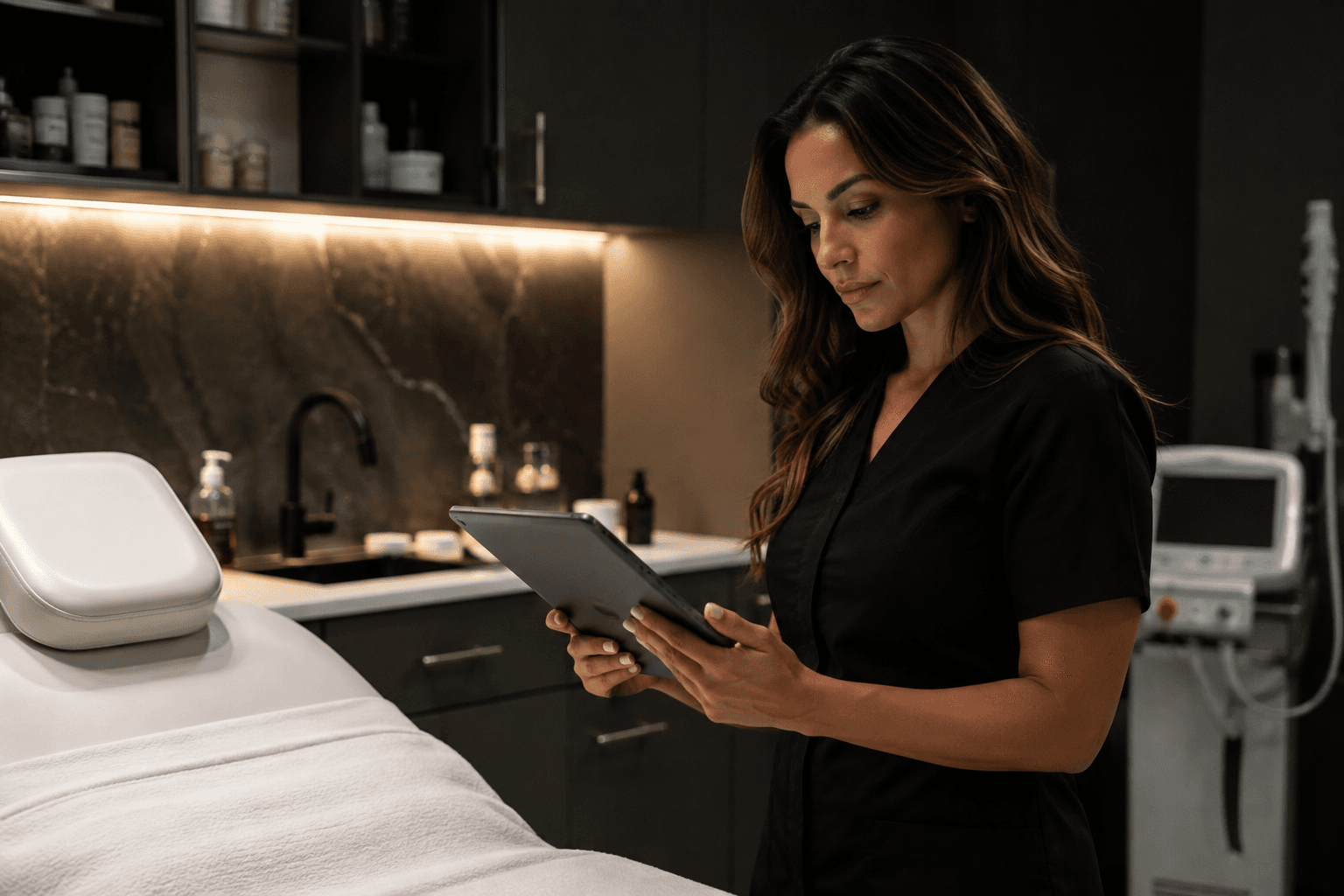
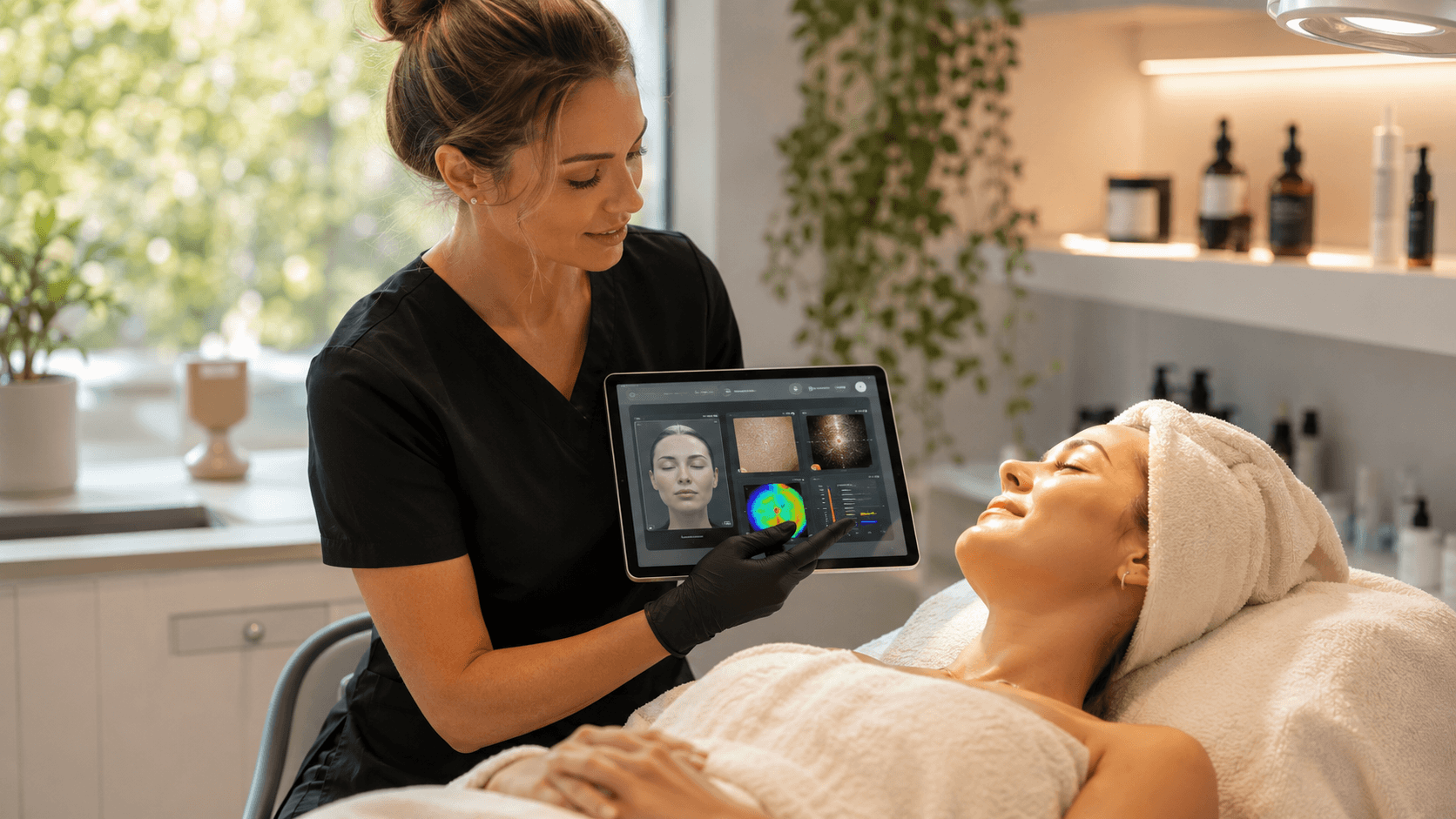
A med spa is not a salon with better equipment.
The scheduling is harder — multiple providers, treatment rooms, and devices that can only be in one place at a time. The paperwork is heavier, because consent and contraindication screening are not optional. The revenue is built on treatment series and recall rather than one-off visits. And the marketing lives inside real constraints, because you cannot promise medical outcomes the way a salon can promise a good blowout.
Most of the software marketed to the beauty industry was designed for the salon version of that problem. It handles a chair and a client. It does not handle a nurse injector, a laser room, a signed consent from four months ago, and a client who is due for her next appointment in the window where results actually hold.
That gap is where AI is earning its place in medical aesthetics right now. Not by making clinical decisions — that stays with your providers and your medical director — but by carrying the operational weight that keeps a clinical practice running.
Here are five categories of AI tools genuinely changing how med spas operate in 2026.
1. AI Consultation Support and Treatment Planning
The consultation is where a med spa is won or lost. It is also the part of the day that is hardest to make consistent, especially once you have more than one provider.
What AI Consultation Support Can Do
- Draft consultation frameworks so every provider asks the same intake questions in the same order
- Turn a provider's shorthand notes into a clear, written plan the client can actually read and follow at home
- Prepare the client-facing explanation of a treatment series — timing, expected number of sessions, aftercare, what to avoid
- Build pre- and post-treatment instruction sheets per service, in English or Spanish, without rewriting them every time
- Summarize a returning client's history before you walk into the room
Why It Matters
Inconsistency between providers is one of the quietest problems in a growing med spa. Two injectors can be equally skilled and still send clients home with completely different expectations. When one client was told results last three months and another was told four, you get the same phone call either way — except now it sounds like nobody knows.
AI cannot standardize your clinical judgment, and it should not try. What it can standardize is the communication around it: the questions asked, the plan written down, the aftercare handed over.
What to Look For
Look for a tool you can train on your own protocols and your own language, rather than one producing generic content that sounds like it came from anywhere. A general chatbot does not know that your practice sequences treatments a specific way. A trained assistant does.
And draw the line clearly: AI drafts the explanation. A licensed provider decides the treatment. Anything that blurs that line is a liability, not a tool.
2. Scheduling That Understands Providers, Rooms, and Devices
Salon booking software asks one question: is this person free? Med spa booking has to answer four at once — is the provider free, is the room free, is the device free, and is this client actually eligible to be treated today?
What AI Scheduling Does for a Med Spa
- Books against provider and room and device availability instead of a single calendar
- Respects the interval a treatment requires, so a client cannot self-book a series appointment too early
- Holds deposits on high-value appointments, where a single no-show is a serious revenue loss
- Sends reminders that carry pre-treatment instructions, not just a time and date
- Flags gaps a human scheduler would miss and suggests which waitlisted clients could fill them
The Real Impact
Run the math on your own numbers rather than an industry average. A no-show on a $90 facial is annoying. A no-show on a four-figure device treatment, in a room that was blocked for ninety minutes, with a provider on the clock, is a genuinely bad day.
That asymmetry is why deposits and confirmations matter more in medical aesthetics than almost anywhere else in beauty. If you have not tightened this, our guide on reducing no-shows at your salon or spa covers the mechanics — they apply with more force here.
The reminder content matters too. "Avoid retinoids for five days before your appointment" sent automatically, at the right time, prevents same-day cancellations that no amount of front-desk effort can recover.
3. AI Intake, Consent, and Contraindication Screening
This is the category where med spas differ most from the rest of the beauty industry, and the one where the wrong tool creates real exposure.
What AI Can Do Here
- Generate intake forms per service, so a laser consult does not use the same questionnaire as a hydrating facial
- Collect health history, medications, and allergies before the client arrives, not in the waiting room
- Surface answers that warrant provider review — a medication, a recent procedure, a condition worth a second look
- Keep signed consent stored and retrievable against the client's record instead of in a filing cabinet
- Re-collect what needs re-collecting, because consent from eight months ago may not cover today's treatment
The Part Nobody Wants to Talk About
Screening is a clinical function. AI can be very good at collecting and organizing the information, and at putting the right answer in front of the right person at the right moment. It should not be the thing that decides whether a client is safe to treat. That decision belongs to a licensed provider working under your medical director.
Be equally careful about where those records live. Requirements for medical record handling vary by state and by how your practice is structured, and HIPAA obligations depend on facts specific to your business. Before you move health history into any platform, confirm with your medical director and your own compliance counsel that the arrangement fits your requirements. Ask vendors direct questions about encryption, data retention, access controls, and whether your data is used to train models — and get the answers in writing.
That is not a reason to stay on paper. Paper forms get lost, go unsigned, and are impossible to search when you actually need them. It is a reason to choose deliberately. Our guide to digital intake forms for beauty professionals walks through what belongs on a form and why.
4. AI Client Records and Treatment History
Med spa revenue does not come from appointments. It comes from sequences of appointments — and sequences fall apart when nobody is tracking where each client is in theirs.
What Smart Records Do for Medical Aesthetics
- Hold the full treatment timeline: what was done, by whom, when, with what settings or product
- Keep photo documentation attached to the visit it belongs to, with consent recorded
- Track where a client sits in a series and what comes next
- Trigger recall at the interval the treatment actually calls for, rather than a generic "we miss you" at ninety days
- Give any provider the context to pick up a client they have never personally treated
Why This Changes the Economics
A client who completes a recommended series is worth several times a client who does one session and drifts. The difference is rarely enthusiasm. It is usually that nobody reached out at the right time.
Generic retention tactics underperform in this category because the timing is clinical, not seasonal. A neurotoxin client and a resurfacing client are on completely different clocks. Recall that respects those clocks converts; recall that ignores them reads as marketing and gets ignored. The broader principles in our client retention guide still hold — the intervals just have to come from your protocols.
Provider continuity is the other half. When an injector leaves, the practice keeps the client relationship only if the record is complete enough for someone else to step in confidently.
5. AI Content and Marketing Inside Real Constraints
Marketing a med spa is harder than marketing a salon, and not because the audience is harder to reach.
The Constraints Are Real
You cannot make outcome promises you are not permitted to make. Prescription treatments carry advertising restrictions, and the major ad platforms enforce their own policies on top of the law. Before-and-after imagery requires explicit consent for that specific use, which is a different consent from the one authorizing treatment.
What AI Can Do Within Them
- Draft educational content about categories of treatment rather than outcome claims
- Produce a consistent posting cadence so your feed does not go quiet for three weeks whenever the schedule fills
- Generate branded visuals for promotions, seasonal messaging, and service explainers without a photographer
- Write the same campaign in English and Spanish with equal care, rather than running one through a translator
- Adapt one educational piece into a post, an email, and a website section
The Strategic Advantage
Med spa clients research before they book, often for weeks. The practice that answers questions clearly and consistently earns the consultation before the client ever fills out a form.
AI makes that consistency achievable for a practice that does not have a marketing department. What it does not do is decide what you are allowed to claim — have someone who knows your regulatory footprint review your messaging, especially anything about prescription treatments.
How Med Spas Should Start With AI
Do not roll out five categories at once. Start where your practice is actually bleeding.
If Your Problem Is Paperwork and Exposure
Start with intake and consent. Get forms collected before arrival and signed consent stored against the record. It is the fastest reduction in both administrative load and risk.
If Your Problem Is Empty Provider Hours
Start with scheduling and deposits. Multi-provider, multi-room booking with real deposit handling protects the appointments that carry your margin.
If Your Problem Is Clients Who Do One Treatment and Vanish
Start with records and recall. Track series progress and reach out on clinical intervals instead of calendar ones.
If Your Problem Is Inconsistent Providers
Start with consultation support. Standardize the questions and the written plan so every client hears the same thing.
What AI Should Never Do in a Med Spa
Worth stating plainly, because the marketing around AI in aesthetics has gotten loose.
AI should not screen a client for treatment eligibility on its own. It should not recommend a specific treatment, dose, or device setting. It should not answer a clinical question from a client without a provider reviewing it. It should not be your medical record system of authority unless you have verified that it meets your obligations. And it should not generate before-and-after imagery presented as real client results — that is not marketing, it is fabrication.
Everything on the useful side of that line is administrative: collecting, organizing, drafting, scheduling, reminding, documenting. That is a large amount of work, and handing it off is worth doing.
The Med Spas That Get This Right Will Compound
Medical aesthetics is getting more competitive, and the practices pulling ahead are not the ones with the newest device in the room.
They are the ones where consent is always signed and always findable. Where the provider walks in already knowing the history. Where clients are contacted at the interval that keeps results holding. Where every provider explains the plan the same way. Where the schedule protects the hours that pay for everything else.
None of that is glamorous. All of it compounds.
AI is what makes it achievable without hiring an operations manager before you can afford one.
ProBeauty AI is built for beauty and aesthetics professionals who want one modern platform for booking, client records, intake and consent forms, marketing, and AI-powered business support. You bring the clinical expertise. We handle the admin. Get started free.