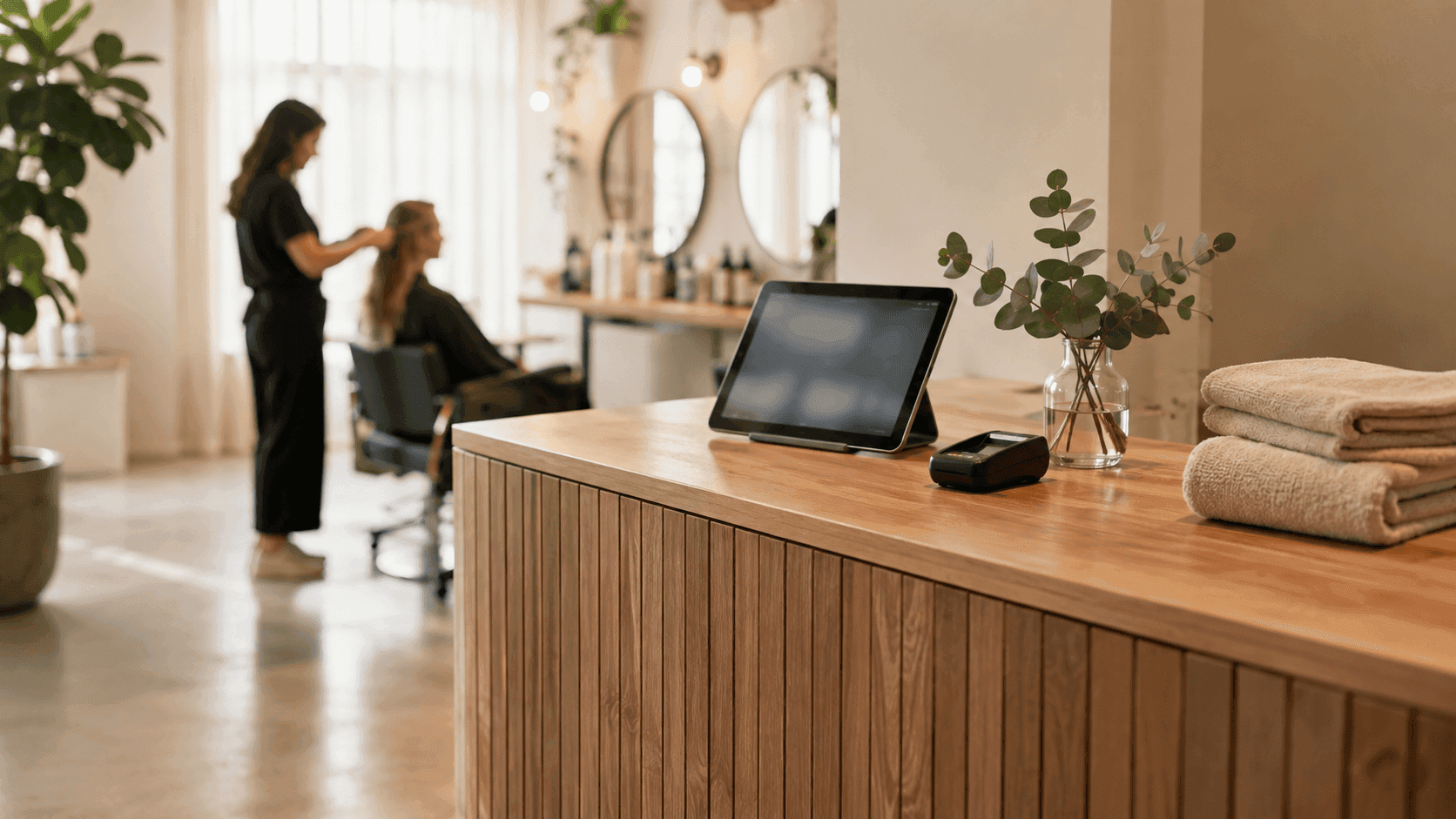
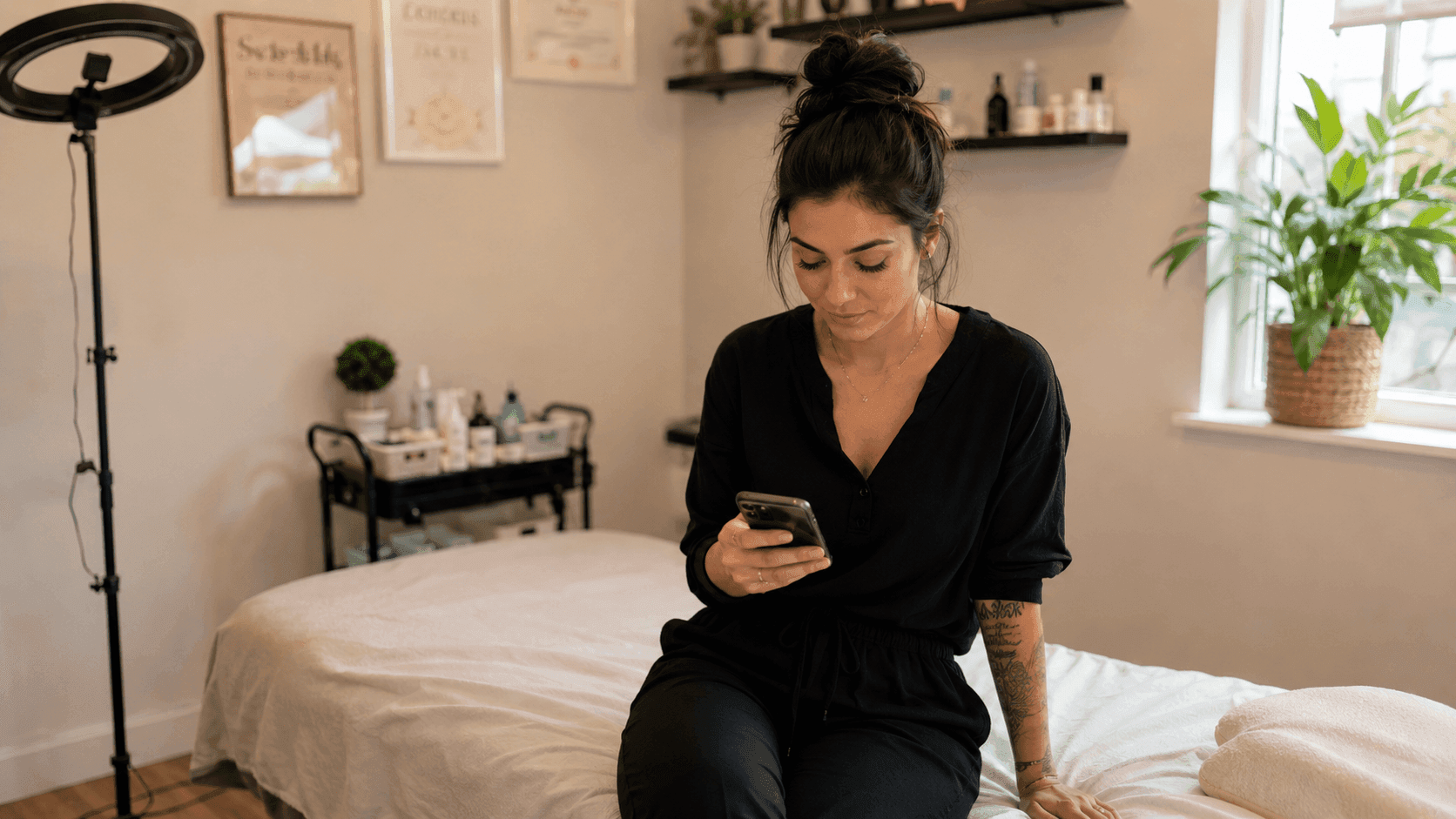
There is a specific point in a salon's growth where the owner starts doing math on a napkin.
You are three chairs in. The phone rings while your hands are in someone's hair. Bookings come in through Instagram, through text, through a link in your bio, and through a woman who just walks in and stands there waiting for someone to notice her. You have missed two calls today and you know one of them was a new client, because she left a voicemail that started with "hi, I was wondering if you had anything Saturday" and ended with her calling somewhere else.
So you start pricing a receptionist. And then you see the number, and you start pricing software instead.
That comparison is the one people search for, and it usually gets answered badly. Software companies say AI replaces your front desk. Staffing people say nothing replaces a human. Both are selling something. I run a company that sells the software, so treat this accordingly, but I would rather tell you where it genuinely does not work than have you buy it and find out yourself.
You are not choosing between a robot and a person
The framing is wrong, and it is why people make the wrong call.
"Front desk" is not one job. It is about nine jobs that happen to be done by whoever is standing near the door. Before you can compare anything, you have to break it apart:
- Answering the phone
- Taking and changing bookings
- Answering the same eleven questions about pricing, parking, policies, and whether you do balayage
- Sending reminders and chasing confirmations
- Greeting people, taking coats, offering water, managing the wait
- Checkout, tips, and rebooking on the way out
- Selling retail
- Chasing no-shows and filling gaps
- Absorbing the emotional weather when something goes wrong
An AI receptionist is very good at four of those and structurally incapable of three of them. A part-time person is decent at all of them and available thirty hours a week. Those are not competing products. They are different tools, and which one you need depends entirely on which of those nine jobs is actually costing you money right now.
So the useful question is not "AI or a human." It is: what is my front desk failing at, and what fixes that specific failure?
What an AI receptionist genuinely handles
Being specific here matters, because "AI handles your front desk" is a sentence that means nothing.
Booking without you. A branded booking page that takes appointments at 11pm on a Sunday, knows your service durations, blocks your buffer time, and does not double book you. This is the single largest win, and it has nothing to do with AI. It is just scheduling that works while you are busy.
Answering the repeatable questions. Rates, policies, deposit terms, cancellation windows, what a service includes, how long it takes, whether you have parking. An AI assistant trained on your actual services and policies answers these instantly and consistently, at 2am, in the same tone every time. A human receptionist answers them well, but only during their shift, and their sixtieth answer of the day is worse than their first.
Reminders and confirmations. Automated SMS, sent on schedule, every time, with no one forgetting. This is where most of the no-show reduction actually comes from. Our guide to reducing no-shows goes deep on this, but the short version is that consistency beats charm.
Intake before the appointment. Forms sent ahead, filled at home, attached to the client record before they walk in. A receptionist handing someone a clipboard in the waiting room gets you a worse form and a client who is already annoyed.
The record itself. Who they are, what you did last time, what they reacted to, what they said they wanted to try. A good receptionist keeps this in their head, which is wonderful until they leave. See where to store client notes and consent forms for why that matters more than it sounds.
Notice what these have in common. They are all high-volume, low-judgment, and identical every time. That is exactly the shape of work software is good at.
What still needs a person
I want to be blunt about this, because the honest limits are the useful part.
The room. Someone walks in, and in the first six seconds they decide whether this place is nice. Nobody has automated that. A calm person who looks up, uses their name, and takes their coat is doing something a booking page cannot do at any price.
Judgment calls. A client is upset about a color. A double booking happened. Someone shows up ninety minutes late for a two-hour service and there is a client behind her. These need someone who can read the situation and decide what to give away to keep a relationship. AI should never be making that call, and I would be suspicious of anyone telling you otherwise.
Retail. Selling product is a conversation, and it happens while someone is standing at the counter with their card out. Automated retail suggestions exist and they are fine. They are not a person saying "this is the one I use on your kind of hair."
Phone calls, specifically. This is worth saying clearly because it is the thing people assume AI does. Plenty of tools now answer inbound calls with a synthetic voice. Some are impressive. But an older client who has been coming for fifteen years and wants to move her Thursday is going to hate it, and you will not find out she hated it, because she will not tell you. She will just stop calling. ProBeauty AI does not answer your phone. We moved booking somewhere better instead, which I think is the right trade, but it is a trade and you should know that going in.
Holding it together on a Saturday. At full capacity, with a wait, with a late client and a delivery and a phone ringing, someone has to be the person who absorbs all of it. That is a human job.
The money, honestly
Here is the arithmetic. Use your own local numbers, because wages for salon reception vary enormously by market and mine would just be a guess about your city.
Cost of a person. Take your local hourly rate, multiply by hours per week, multiply by 52, divide by 12. Then add roughly 10 to 15 percent for employer payroll taxes, and more if you offer any benefits. As an illustration only: someone at $17 an hour for 30 hours a week is about $2,210 a month in wages, call it $2,450 loaded. Full time, closer to $3,200. Then add recruiting time, training time, and the cost of doing it again in fourteen months when they leave, because front desk turnover is real.
Cost of software. Our Essential plan is $19.99 a month and Pro is $29.99. Comparable platforms sit in the same general range. There is a limited-time offer running at $20 for six months. That is $20 once rather than $20 a month, paid today with nothing further until month seven, so it works out to a bit over three dollars a month during that window.
Those numbers are so far apart that the comparison feels absurd, and this is exactly where people reason badly. They are not buying the same thing. One of them greets your clients. The other one takes bookings at midnight. If you swap a person for software and expect the room to feel the same, you will be disappointed, and it will show up in your retention numbers three months later rather than immediately, which makes it hard to trace.
The genuinely useful version of the math is different. Ask: what is the front desk supposed to earn back?
A receptionist at $2,450 a month has to generate roughly that much in recovered revenue to break even. At an average ticket of $85, that is about 29 additional appointments a month, or a bit over one a day. That is achievable if you are currently missing a lot of calls, losing walk-ins, and failing to rebook people on the way out. It is not achievable if your calendar is already mostly full and your problem is that booking is inconvenient after hours.
Run that same test on software. At $20 a month, it breaks even if it saves one appointment. Not one a day. One. If a single client books at 10pm who otherwise would not have, or a single no-show gets prevented by a reminder that actually sent, it has paid for itself and then some. That is not a claim about how good the software is. It is just what happens when the denominator is that small.
When you should actually hire
Some honest thresholds, roughly in order.
Hire when the room needs someone. If clients wait, if there is a real reception area, if people walk in off the street, if your stylists are getting interrupted mid-service to handle checkout. That is a staffing problem and software will not touch it.
Hire when you are at four or more service providers. Somewhere around there the coordination load exceeds what any one working stylist can absorb between clients. The exact number depends on your service lengths, but the feeling is unmistakable: everyone is slightly behind all day for no identifiable reason.
Hire when retail is a real line item. If product is more than a token part of your revenue, a person at the counter pays for themselves in a way no automation currently matches.
Hire when your calls are genuinely high volume and your clientele is phone-first. Some books skew older, some services need a real conversation before booking, some markets just call. You know which one you are.
Do not hire yet if you are solo or two chairs, your bookings mostly come from Instagram and your booking link, and your real problem is that you cannot answer messages while working. That is not understaffing. That is a workflow problem, and hiring a person to solve it is an expensive way to avoid setting up a booking page.
If you do decide to hire, hiring and managing salon staff covers the part that comes after the decision, which is usually the harder part.
What most salons actually end up doing
Almost nobody who thinks this through ends up at either pole.
The setup that works, over and over: automate the hours nobody is there, and staff the hours that matter.
Bookings, questions, reminders, and intake run automatically around the clock. That covers evenings, Sundays, the middle of a color service, and the four hours between when a bride gets engaged at 11pm and when you wake up. Then you put a person on the floor for your busiest stretches, and their job is the room, checkout, retail, and the judgment calls. Not answering "how much is a haircut" for the ninth time.
The practical effect is that you can often hire part-time instead of full-time, or keep the person you have and stop losing bookings overnight. That is a meaningfully cheaper outcome than either extreme, and it is why I think the "replace your receptionist" pitch is both wrong and unnecessary. The software does not need to replace anyone to be worth $20.
How this works in ProBeauty AI
Concretely, so you can judge it rather than take my word for it.
You get a branded booking page at your own URL that takes appointments 24/7, with your services, durations, buffer time, and availability rules. Gia, our AI assistant, handles the booking conversation and answers questions based on your actual services and policies rather than a generic script. Automated SMS confirmations and reminders go out on schedule. Intake and consent forms get sent ahead of the appointment and attach themselves to the client record. Every client has a profile with full visit history, so whoever is working knows what happened last time.
On Pro, you add team collaboration, so multiple staff share a calendar and each person has their own login. That matters more than it sounds once you have anyone besides yourself.
What it does not do: answer your phone, greet anyone, sell retail at the counter, or decide what to comp when a color goes wrong. Those are still yours. If your front desk problem is one of those four, buy something else, or hire.
For the wider picture of what else runs on this stack, AI tools for salon owners covers the rest, and best salon software with AI features puts it next to the alternatives.
Test it before you decide
You do not have to guess. Two weeks of data settles this.
Count your missed calls and unanswered messages for one week. Actual count, written down. Most owners guess low by half.
Note what each one wanted. Booking, rescheduling, a price question, or something that needed a real person. Sort them into those four buckets. The distribution tells you the answer directly. If eighty percent are booking and price questions, that is software. If a third of them needed judgment, that is a person.
Turn on online booking and reminders and count again the next week. If the missed contacts drop to near zero and your calendar fills, you have your answer for a few hundred dollars a year. If they do not, you have learned something worth far more than the subscription cost, which is that your problem was never the booking.
That second week costs you almost nothing and removes the guesswork from a decision that otherwise runs $30,000 a year.
The bottom line
An AI receptionist and a front desk hire solve different problems that happen to look similar from the owner's chair.
Software wins on availability, consistency, and cost, and it wins by an enormous margin on all three. A person wins on the room, on judgment, on retail, and on the Saturday afternoon when everything goes sideways at once. Neither one covers the other's ground, and any vendor telling you otherwise is hoping you do not find out until after the annual plan renews.
If you are small and losing bookings to the hours you are not available, start with the software. It costs less than one appointment and you will know within two weeks whether it worked. If you are bigger, and the problem is the room rather than the calendar, hire the person and let the software handle the hours they are not there. That combination is cheaper than a full-time desk and better than either half alone.
Whatever you do, count the missed calls first. It is the only part of this that is actually about your business rather than about someone's marketing.
ProBeauty AI gives you 24/7 online booking, an AI assistant that answers client questions in your voice, automated reminders, digital intake, and full client records, starting at less than a single appointment. You focus on the human touch. We'll handle the rest. Get started free.