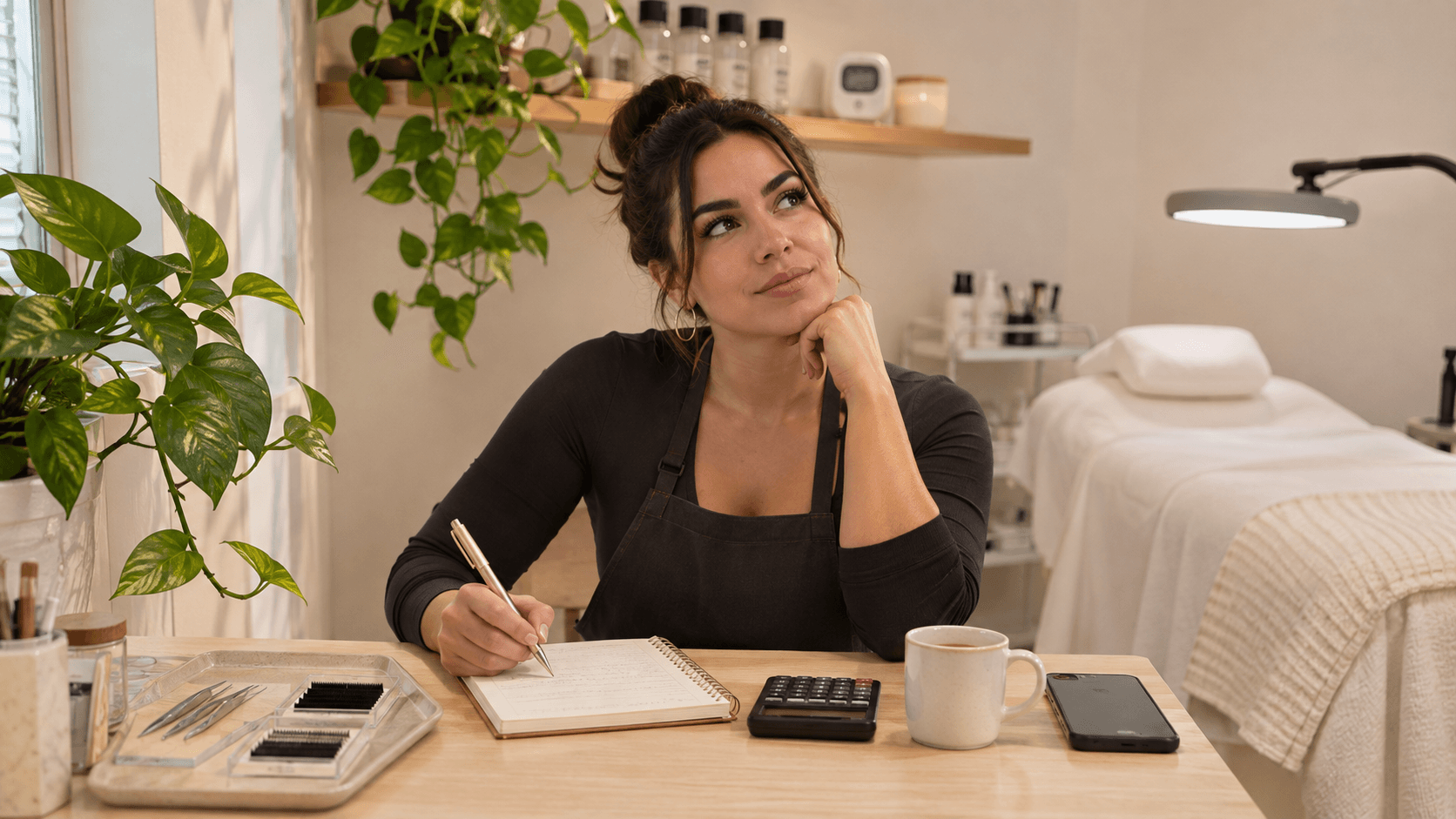
Here is the number most people are looking for.
According to a 2026 cost study published by CareCredit, the national average price of a classic full set of eyelash extensions is $165, with a typical range of $120 to $275. By type, the averages are:
| Full set | National average | Typical range |
|---|
| Classic | $165 | $120 to $275 |
| Hybrid | $185 | $135 to $310 |
| Volume | $215 | $160 to $355 |
| Mega volume | $285 | $215 to $460 |
Location moves it a lot. The same study puts the average classic set at $200 in California and $195 in Washington, DC, and at $140 in Arkansas and Mississippi.
Now the part that matters more: that is what clients pay on average. It is not what you should charge.
An average blends a first-year artist in a rented room with a fifteen-year educator who has a waitlist. It blends a two-hour classic set with a ninety-minute one. It says nothing about your rent, your adhesive, or how many fills you can do in a day. Price off the average and you are guessing. Price off your own numbers and you know.
This guide walks through how to set your full set price, how to price fills properly, which is where most lash artists lose money, and how to check yourself against your local market.
Start with your floor, not the average
Your floor is the lowest price at which a service actually pays you. Below it you are working for less than you meant to, or paying for the privilege.
The formula is the same one we use for every service, covered in full in how to price your beauty services:
Minimum price = Product cost + (Overhead per hour × Total time) + (Your hourly rate × Total time)
Three things make lashes different from most services.
Total time is long, and it is more than the application. A full set is consultation, cleansing, isolation, application, aftercare instructions, rebooking and resetting the room. Time the whole thing, door to door, for your last five sets. Use something close to the slowest of those, not your best day.
Product cost is small per set but adds up. Lash trays, adhesive (which has a short shelf life once opened), primer, under-eye pads, tape, micro swabs, disposable mascara wands, cleanser. Work it out per set, including the adhesive you throw away.
Overhead per hour is higher than it looks, because you can fit far fewer clients into a day than a stylist or nail tech can. Rent divided across four sets a day costs each set a lot more than rent divided across eight appointments.
A worked example
These numbers are illustrative only. Use your own.
- Product and disposables: $12 per set
- Overhead: $25 per hour
- Total time for a classic full set, door to door: 2.5 hours
- The hourly rate you want to earn: $45
$12 + ($25 × 2.5) + ($45 × 2.5) = $12 + $62.50 + $112.50 = $187
That is the floor. Not the price you charge, the price below which this service stops paying you what you decided you are worth. Notice that in this example it already sits above the national average for a classic set. That is common, and it is exactly why pricing off the average is dangerous.
Price the ladder by time and skill
Classic, hybrid, volume and mega volume differ mainly in two things: how long they take you, and how much skill they demand. Your prices should step up in proportion.
Time each one. If your volume set takes an hour longer than your classic, that hour has to be in the price. Run the formula for each service separately rather than adding a flat amount on top of classic.
Charge for skill on top of time. Volume and mega volume take training, practice and a steadier hand. That is worth paying for even when the time difference is small.
Keep the menu short. Four set types, their fills, and a removal is plenty. Clients cannot tell the difference between eleven variations of hybrid, and a long menu makes them pick the cheapest one that sounds close. Name and describe each service the way clients talk about it, and say how long it takes.
Fills are where the money is lost
Full sets get all the attention. Fills are most of the work.
A client who keeps her lashes up books a fill every few weeks. CareCredit's guide notes that refills are typically needed every two to three weeks, because extensions shed with the natural lash cycle. Over a year, a regular client's fills add up to far more revenue than her full set. Get the fill price and the fill rules wrong and you lose that money quietly, every week.
Price fills by time, too
Time a typical two-week fill and a typical three-week fill. They are not the same appointment. A three-week fill usually needs more lashes replaced and takes longer. Many artists price these separately, and it is the fairest way to do it.
Set a fill window, and a "too far gone" rule
This is the single most important policy in a lash business.
Fill window: how long after the last appointment a booking still counts as a fill. Past that window, it is priced as something more.
Minimum remaining: how much needs to be left for it to count as a fill. A common approach is to set a threshold, such as roughly half the lashes still in place. Below that, it is effectively a new set and should be priced as one, or as a premium fill that sits between the two.
Both rules need to be written down, explained before the first appointment, and applied consistently. A client who arrives with very little left and is charged a fill price is getting most of a full set for much less, and you lose the difference.
Price foreign fills as what they are
A client coming in with another artist's work needs assessment, often partial or full removal, and work in a style you did not choose. Treat it as a new set, or charge a removal fee plus a set. Doing it at fill price is how you end up fixing someone else's work for free.
Removal and patch tests
Removal: a service in its own right, priced by time. Many artists credit the removal fee toward a new set if the client books one.
Patch test: decide whether it is free or charged, and whether a charge is credited toward the full set. Either way, record that it was done and the result in the client's file, alongside her consent. Where those records should live is covered in where to store client notes and consent forms.
Check yourself against your local market
Once you know your floor, look at what clients near you are actually paying.
Pick eight to ten lash artists within the distance your clients would realistically travel. Include people at your level and people a step above.
Write down, for each one: classic, hybrid and volume full set prices, two-week and three-week fill prices, their fill window, and whether they take deposits. Most of this is on their booking pages.
Then place yourself. If your floor is below the local range, you have room to price higher. If your floor is above it, either your costs are high, your time is long, or you are offering something premium and need to make that obvious. Only drop below your floor as a short, deliberate choice, like a new-client offer, never as the default.
Do not compete on price with the cheapest artist in town. A lash business that wins on price has to work faster, which usually means worse retention, which means more fills that are really new sets. Compete on retention, comfort and consistency instead.
Protect the long appointments
A two to three hour set is a big block of your day, and a no-show in that slot is a large share of your daily revenue.
Take deposits on full sets, and on any new client's first appointment. A deposit is not about cash flow. It is about commitment.
Have a cancellation window that is long enough to refill the slot, and make sure clients accept it when they book, not on a sign at your desk.
Book the next fill before she leaves. Right at checkout, while her lashes look perfect. That single habit keeps fills inside your window and keeps your calendar full.
The full mechanics are in how to reduce no-shows and how to set up online booking.
When and how to raise your prices
Review your prices at least once a year, and whenever your costs or demand change. Signs it is time:
- Your book is full and you have a waitlist
- Your adhesive, lashes or rent have gone up
- You have added training or a new technique
- Your floor has drifted above what you charge
Give regulars notice, a few weeks is usually enough, and say it plainly without apologizing. Some artists keep existing clients on the old price for a set period while new clients pay the new one. More on handling the conversation in how to price your beauty services.
How ProBeauty AI helps with lash pricing
Concretely, so you can judge it.
You can set up each set, fill and removal as its own service with its own price, duration and buffer time, so your booking page charges correctly and never sells a three-week fill into a two-week slot. Deposits are included on Essential, so you can protect full sets without upgrading. Intake and consent forms go out before the appointment, and the patch test result sits in the client's record with her history. Appointment reminders go out by text automatically.
You can also ask Gia, our AI assistant, to sanity-check your menu, draft your fill policy in plain language, or write the message announcing a price change.
What it will not do is decide your prices for you. That is still your floor and your market.
Essential is $19.99 a month, or $20 once for your first six months on the current offer, with nothing further until month seven. More on the lash side of the business in AI tools every lash artist should use.
The short version
- The national average classic full set is $165 according to CareCredit's 2026 study, but that is not your price.
- Work out your floor from your real time, costs and the hourly rate you want.
- Step your price up for hybrid, volume and mega volume by time and skill.
- Price two-week and three-week fills separately, and write down a fill window and a "too far gone" rule.
- Charge foreign fills and removals as their own services.
- Check eight to ten local artists, then place yourself on purpose.
- Take deposits on sets and book the next fill at checkout.
Price from your own numbers, apply your fill rules every time, and review it all once a year.
Sources
- CareCredit, Eyelash Extension Cost and Procedure Guide, August 28, 2026, citing the 2026 Synchrony Average Procedural Cost Study for Cosmetic Practices Across the United States, conducted by ASQ360° Market Research. Averages are full sets; the study does not report fill prices.
ProBeauty AI lets lash artists set up every set, fill and removal with its own price and timing, take deposits, send intake and consent ahead of the appointment, and keep patch tests and history in each client's record. You focus on the human touch. We'll handle the rest. Get started free.